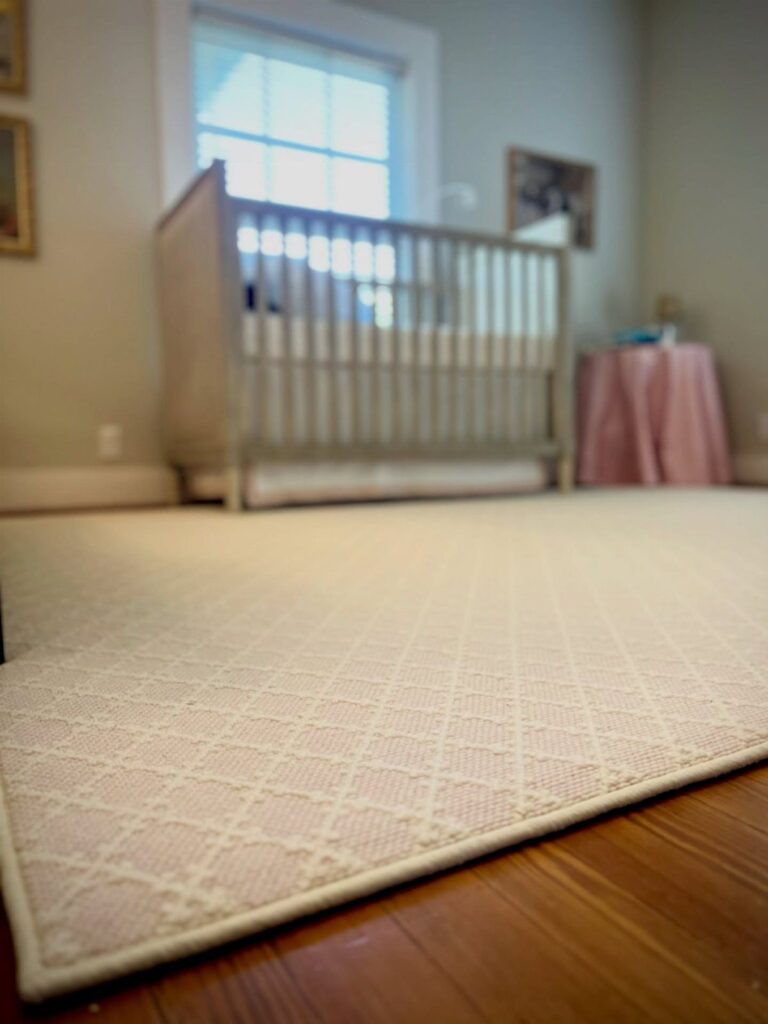
Nursery rugs run from a 6×9 that anchors a play area to a round rug in the middle of the room or a smaller layered piece beside the crib, and the right one depends on the floor: bare wood can take a bordered rug in the open center, while carpet needs a smaller layered rug with a grip pad underneath.
A rug directly under the crib has one firm rule: every leg sits fully on the rug or fully off it, never half on.
1. Rug Placement
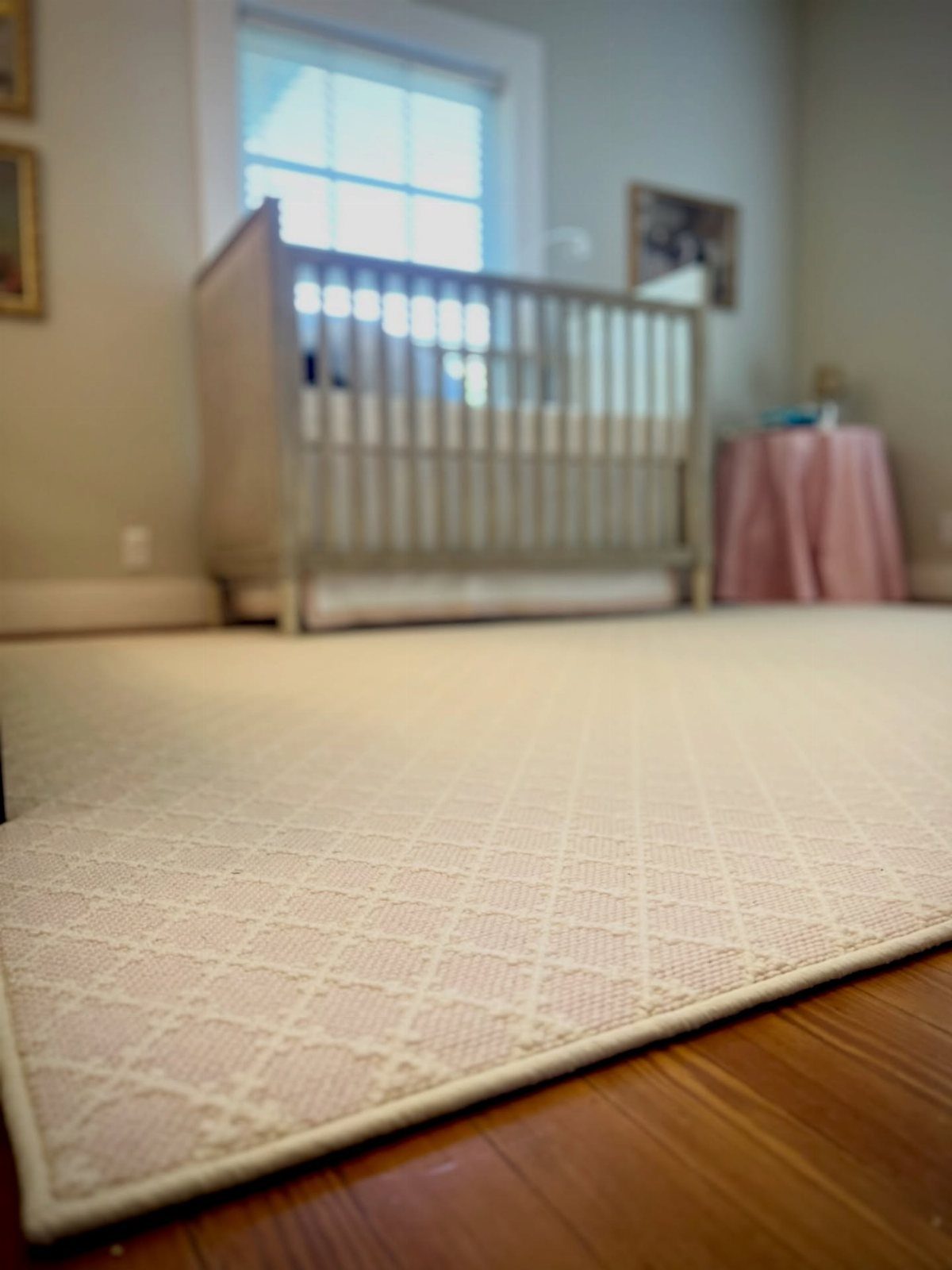
A light patterned rug on a wood floor does 2 jobs: it softens the spot where bare feet and knees land, and it hides small spills better than a solid white would.
Set it so the crib sits fully on the rug or fully off it, with the open floor space on top where you walk and play.
Pick a size that leaves a border of bare wood around the rug. Floor showing on all sides makes the room look larger.
2. Color and Design
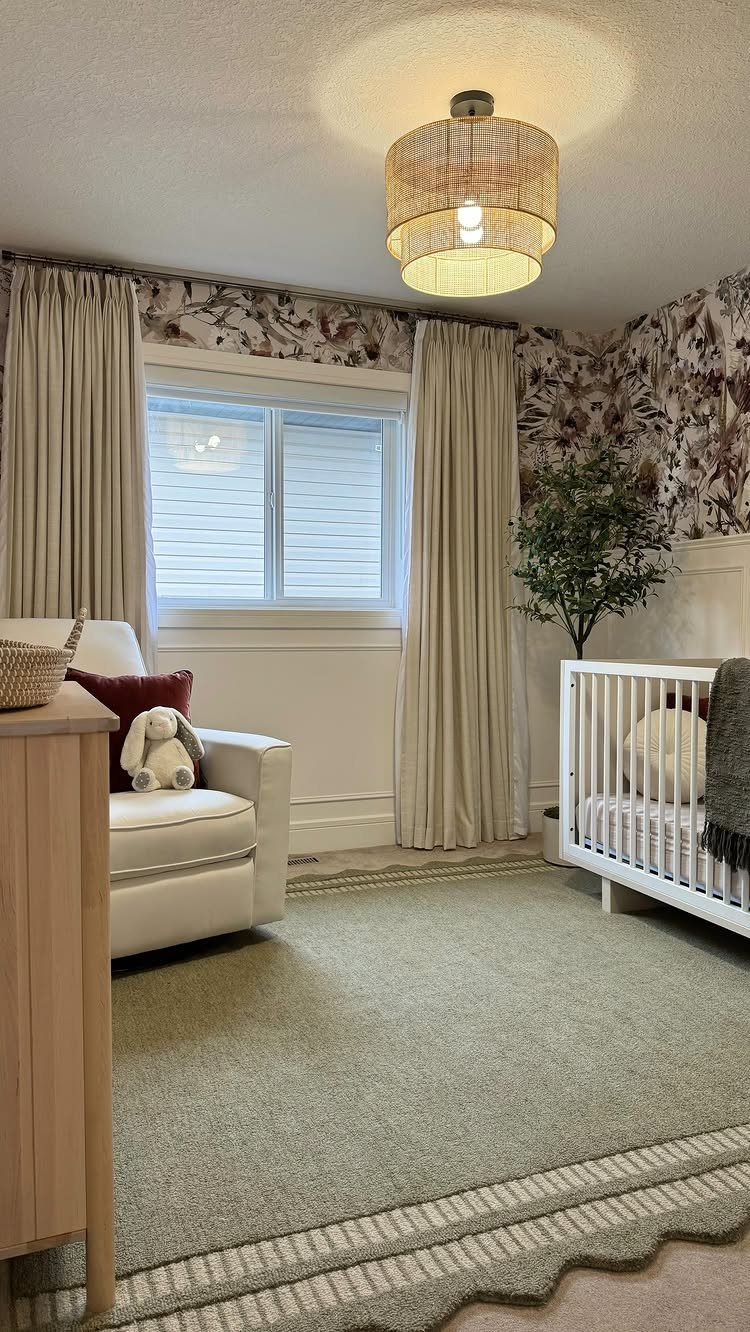
Sage green is an easy color to build a nursery around, and a scalloped edge adds shape without adding pattern. Against floral wallpaper, I’d keep the rug to one soft tone like this so the two don’t compete.
Pull the color from something already in the room, such as a leaf in the wallpaper.
Then the rug reads as planned rather than bought to fill a gap. Busy wallpaper plus a busy rug is the pairing I’d skip.
3. Rug in Play Area
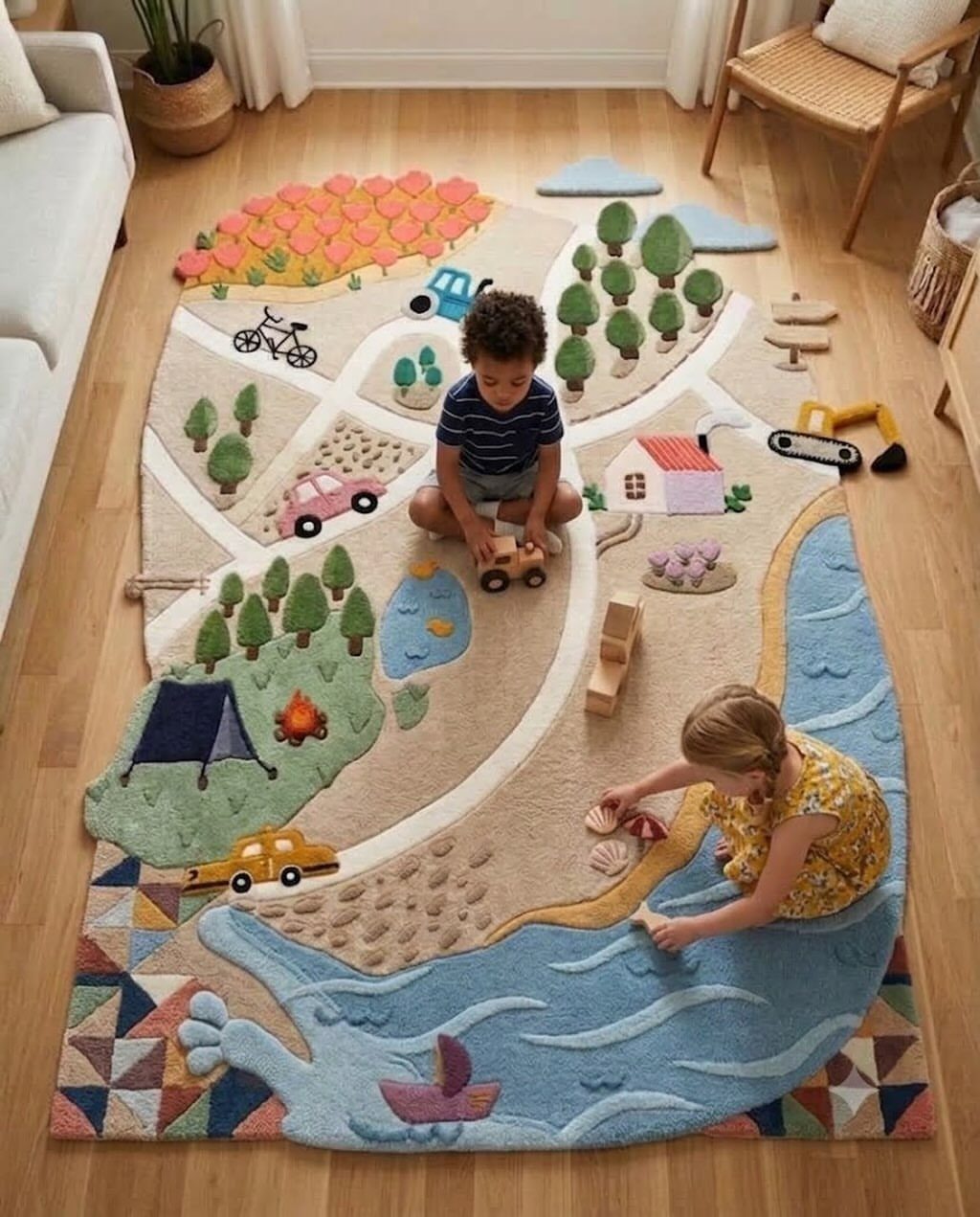
A 5×7 or 6×9 rug marks off a clear patch of floor for play and reading, and that edge helps a child learn where the toys live.
Go with the 6×9 if the room allows it, since two kids or a parent sitting alongside need the extra width.
Place it away from the door so traffic walks around it, not across it. An illustrated design, like a town with roads, also gives toy cars something to drive on.
4. Round Rugs
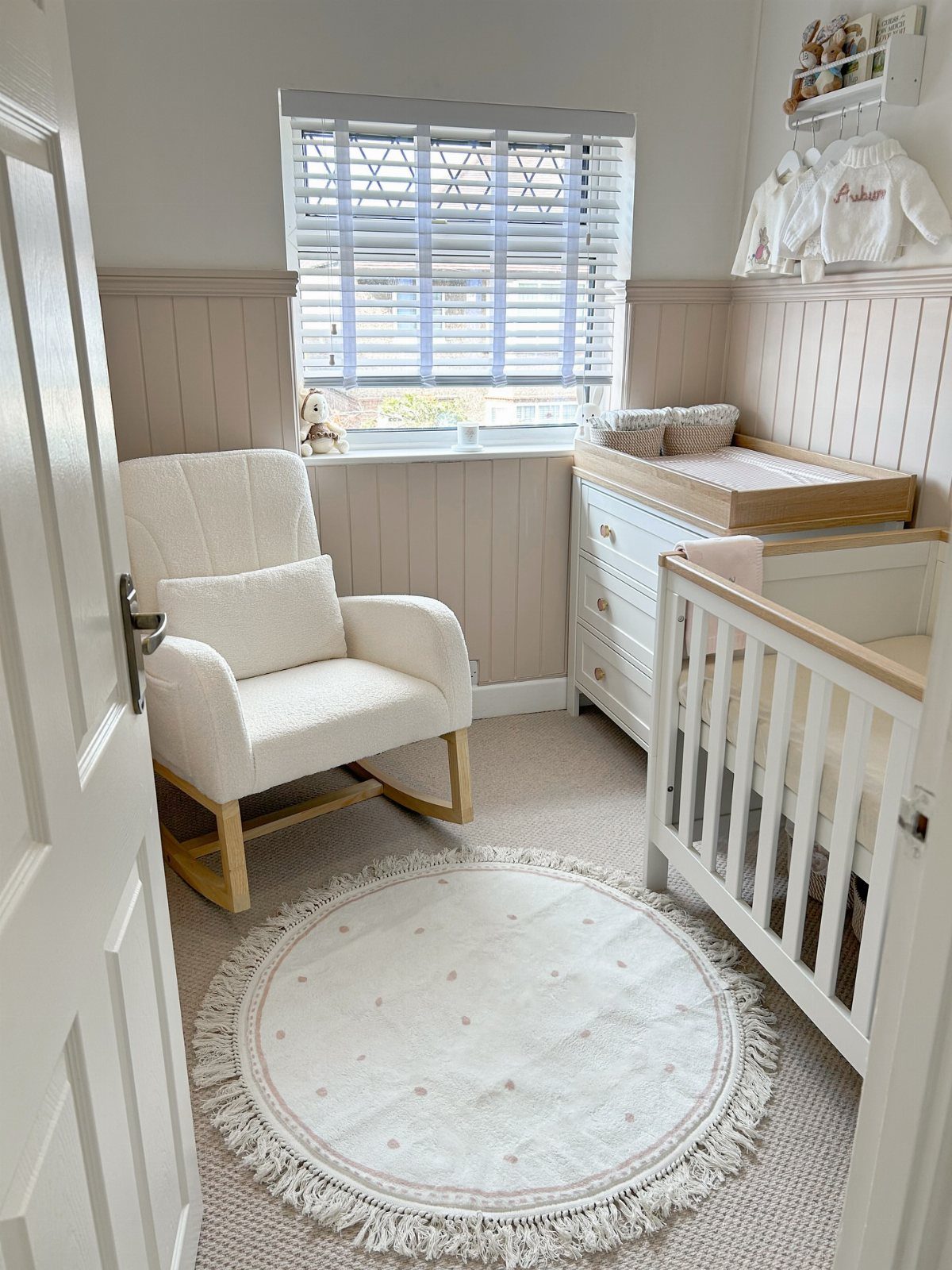
Round rugs have no corners to line up with the walls, so they work in rooms where the furniture sits at odd angles.
Center one in the open floor between the rocking chair, crib and changing table, and let the fringe fall naturally.
A round shape also softens a room full of straight lines: cribs, dressers and window frames. Measure a circle’s diameter against the clear floor before buying, because round rugs look smaller than rectangles of the same width.
5. Centered in the Nursery Room
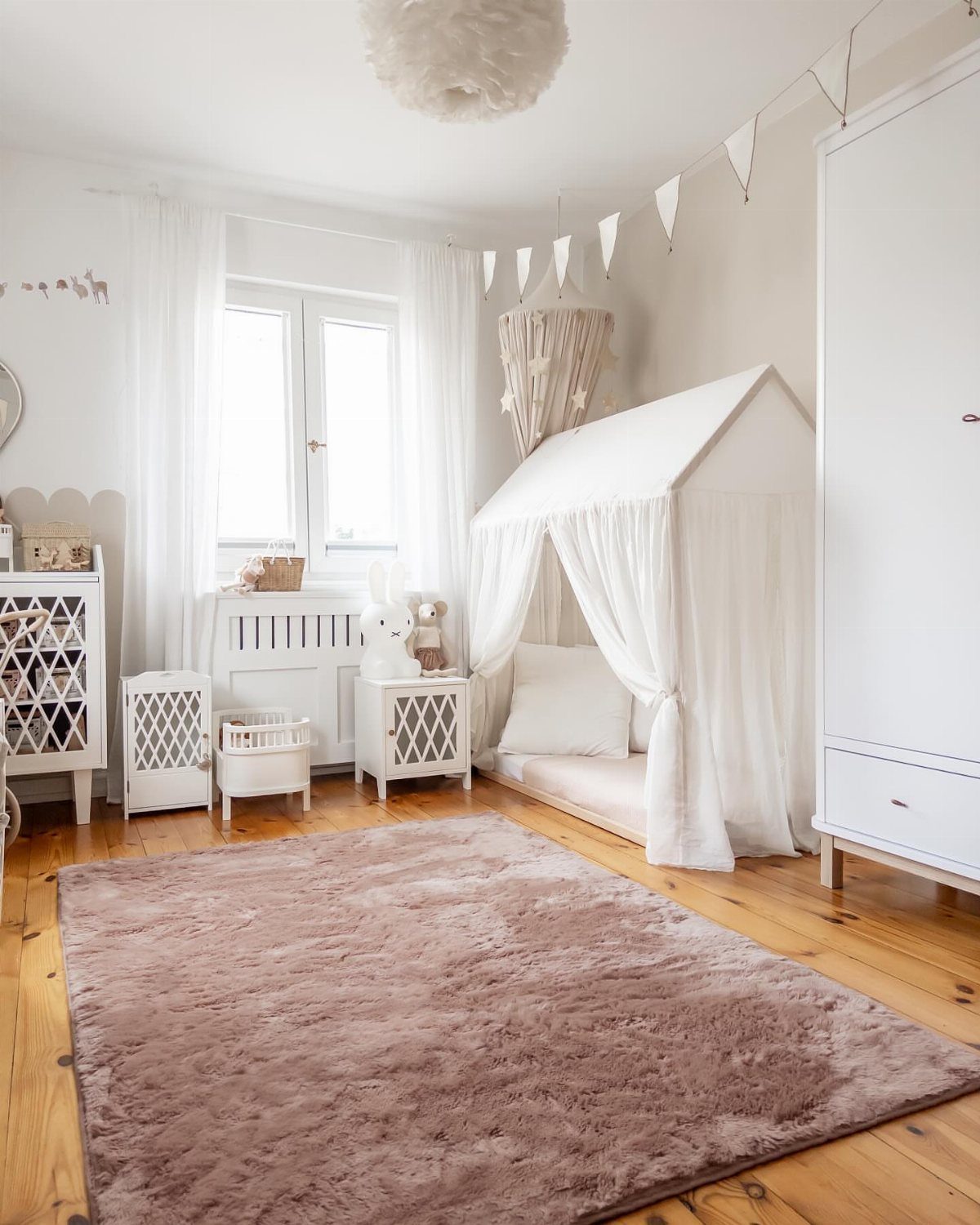
Put a large plush rectangle in the open center of the floor and the whole room settles around it. A soft mauve like this adds color without a pattern, which suits a white nursery with simple furniture.
Choose a rug big enough that the front legs of the larger furniture can touch its edges, or leave an even border of floor all around. Plush pile feels great underfoot, though it holds crumbs, so plan on regular vacuuming.
6. Layered Rug Beside the Crib
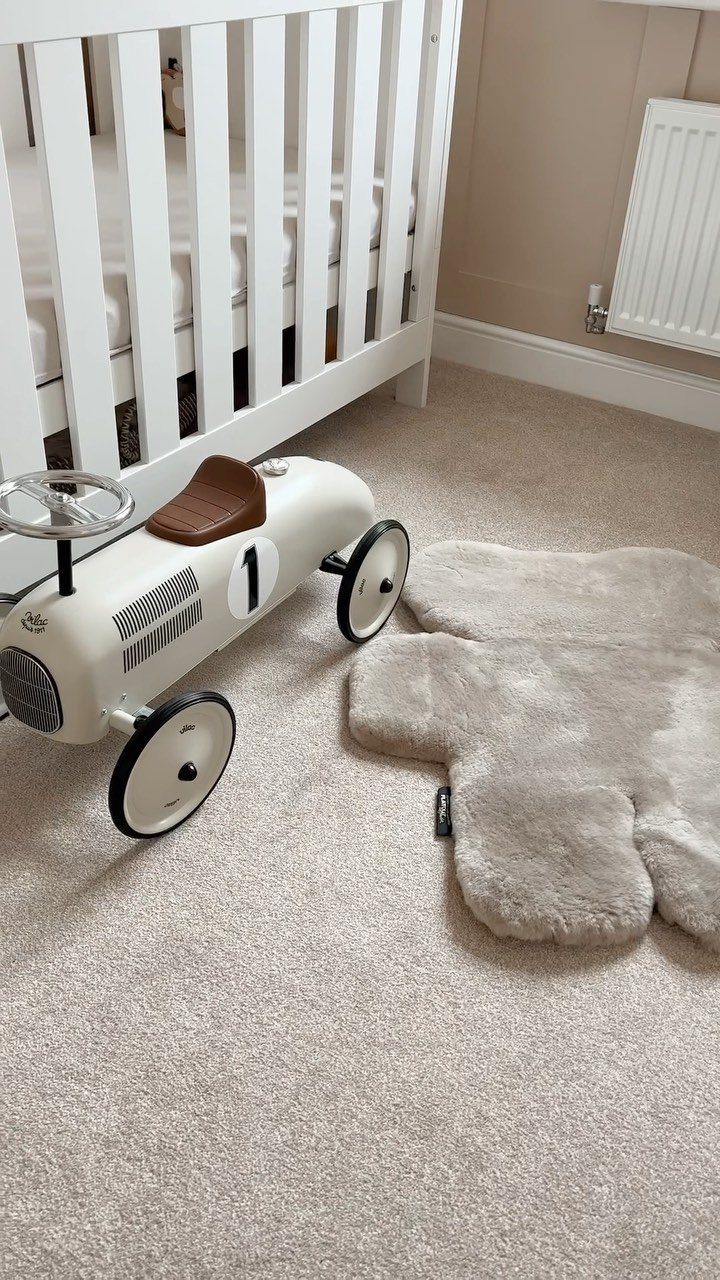
A small faux-fur rug layered over carpet gives you a soft landing spot right beside the crib, where a parent stands during night feedings. It’s a cheap way to add texture without replacing the flooring.
Since it sits on top of carpet, add a rug pad or grip layer underneath so it doesn’t creep or bunch.
Shake it out often. I’d choose a neutral shade like beige so it blends with the carpet rather than fighting it.
7. Directly Under the Crib
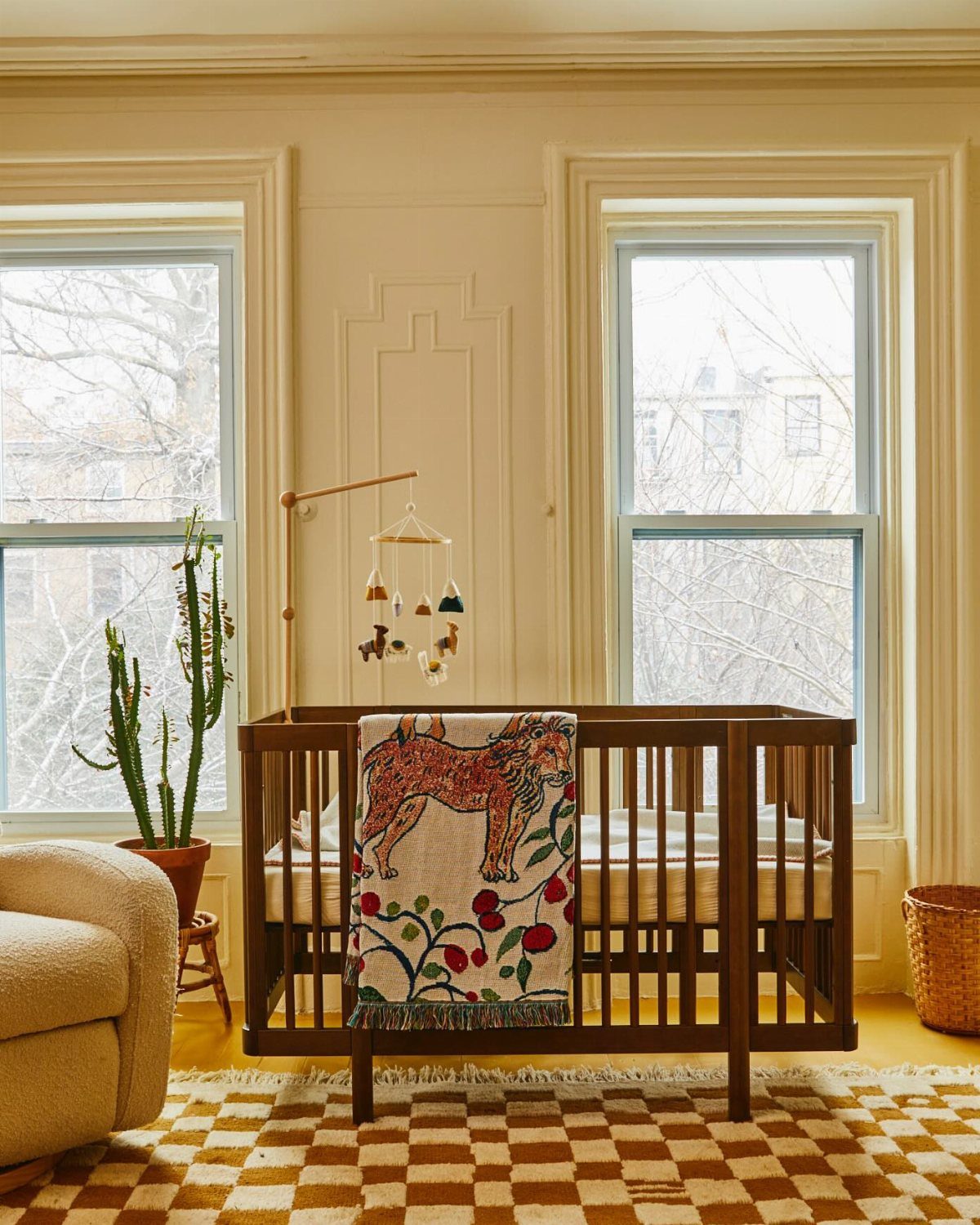
A rug set directly under the crib marks the sleeping corner as its own zone, and a checkered pattern in brown and cream gives that zone a calm, orderly look beside dark wood.
Keep the rug large enough that every crib leg stands fully on it, so the crib doesn’t tilt with one leg half on and half off.
Let the rug run a little past the crib on the side where a parent stands, which gives bare feet something soft during night checks.
A rug pad underneath keeps it from sliding when the crib gets nudged. Because the crib covers much of the rug, I’d spend less here and save the bigger budget for the rug in the open floor.
Rug Maintenance Tips
Machine-washable rugs are the easiest nursery option, because spills and spit-up arrive on a schedule you don’t control.
A washable nursery rug should be thin and stain-resistant enough to keep its shape through repeated cycles, because anything bulky won’t fit in a standard home washer.
Skip high-pile styles.
Dust works its way deep into thick pile, and a very plush rug is hard to vacuum clean. Test your vacuum on the pile height first, since some suction heads and beater bars struggle with anything plush.
Let a new rug air out before it goes into the room, following the maker’s instructions. If anyone in the house has allergies or sensitivities, read the fiber, backing and dye details, and ask a doctor about individual health questions.
Blot spills as soon as they happen and let the floor underneath dry completely; moisture trapped under a rug can warp wood and leave the rug itself musty.
Turning the rug a quarter or half turn every few months spreads out foot traffic and keeps sunlight from fading one side.
Creating Activity Zones
Rugs can mark off separate areas for quiet play, active play and building, and a larger room can hold all three.
A 4×6 suits puzzles, books and drawing, a 6×9 gives room for dancing and physical games, and a 5×7 works for blocks and train sets.
I match the surface to the activity: a plush, quiet rug for reading nooks, a grippy low-pile one where kids run around, and a flat, firm rug with clear edges for block building.
Leave 36 inches of clear path between zones, and keep sightlines open so you can see the whole room from the doorway. Watch the edges where one rug meets another floor area, since those transitions are where people trip.
For a reading or nursing nook, a round rug works well. When the chair and side table all touch it, the rug ties them into one defined corner.
Visual Appeal
Newborns respond to high-contrast patterns, so a black and white zigzag or polka dot rug gives a baby something to look at while keeping the room modern.
If you want color instead, a vintage-style rug in bright pink, coral, terracotta and garnet can be the focal point of the room.
A flat weave is a good pick for that kind of rug, since it cleans up easily and still adds some softness underfoot.
Pastels soothe, and brights stimulate, so choose by what the room needs. Whichever you pick, tie it to the decor with one shared color rather than matching everything.
Frequently Asked Questions
What size rug should go in a nursery?
A 5×7 or 6×9 suits most standard nurseries, and a 4×6 is a practical start for a compact room.
A 6×9 is my pick when the room has space for it, because a parent and a couple of toddlers all need room to sit on the rug at once.
Should a nursery rug go under the crib?
It can, but partial placement is the easier route: a rug that runs beside the crib gives a soft spot for a parent’s feet during night checks.
Most of a rug under the crib never gets seen, so I’d buy a cheaper one for that spot and put the real money into the rug on open floor.





