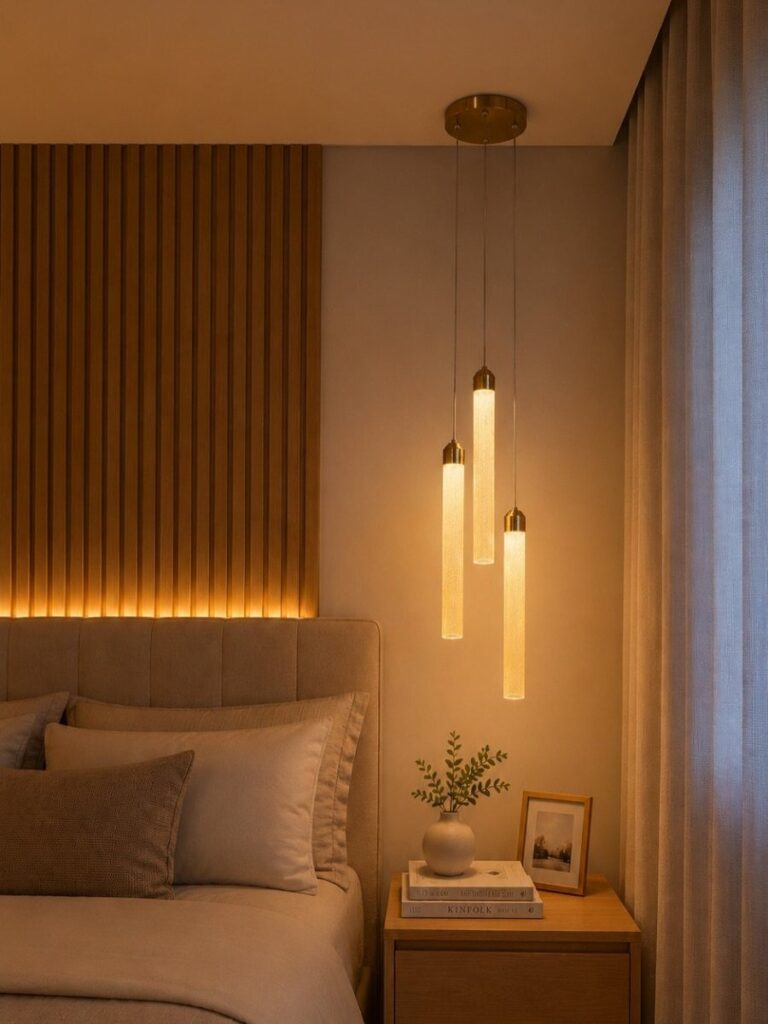
Whether you rent or own decides most of this list: plug-in sconces, a pendant on a swag kit, stick-on LED strips and a lamp on a nightstand need no electrician, while hardwired dimmers and lights built into joinery do.
The ideas run from a lamp or window treatments that soften daylight up to lights built into the walls or ceiling before finish work.
1. Ceiling Fixtures for Ambient Light
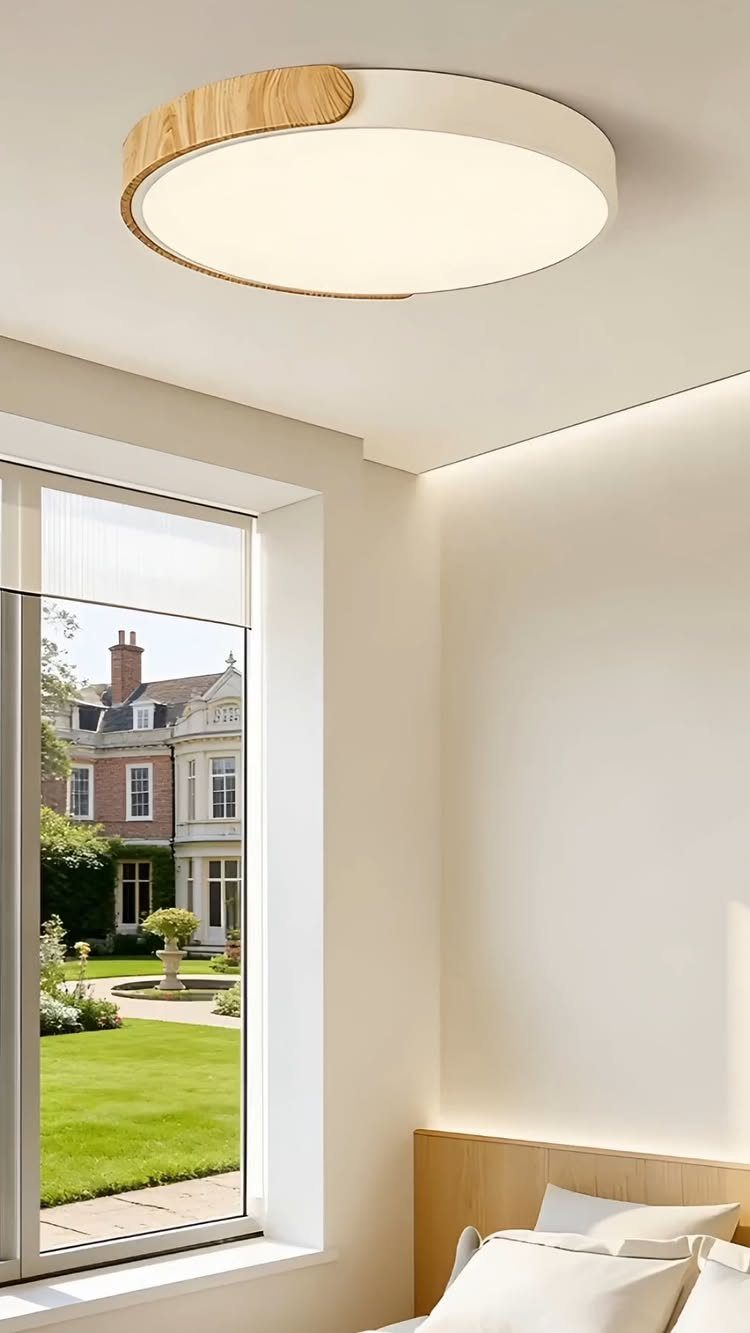
A flush-mount fixture suits a bedroom with a standard-height ceiling, because it sits tight to the surface and leaves nothing hanging to bump or collect dust. The round shape with a wood trim softens a room full of straight lines.
For a weekend swap on a renter’s budget, this is one of the simpler upgrades, since the new fixture replaces the old one on the same ceiling box. Pick a white diffuser so the light spreads evenly instead of pooling.
Turn off the breaker before you unscrew anything.
2. Wall Sconces
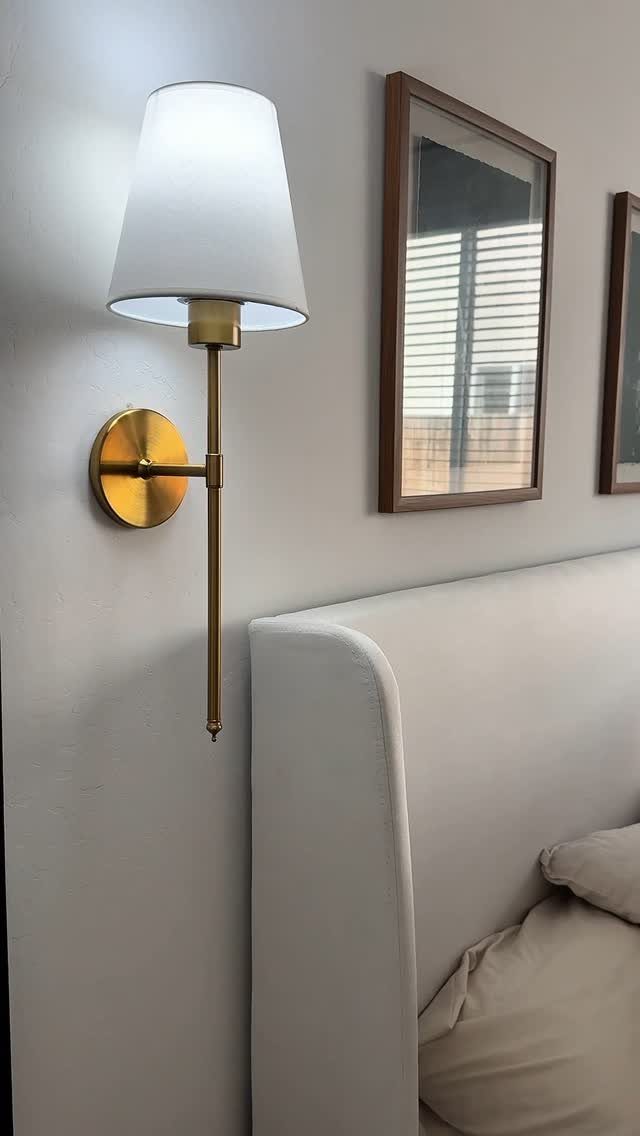
Mounting a sconce beside the headboard frees the nightstand surface completely, which matters in a small room where a lamp base eats half the top. A white shade keeps the glow soft against a grey wall.
I like a gold finish here because it reads warm even when the light is off.
Hang each one at roughly reading height when you sit up in bed, then check it from the pillow before you commit to a hole.
Plug-in versions spare renters the electrician; hide the cord with a cord cover painted to match the wall.
3. Pendant Lights
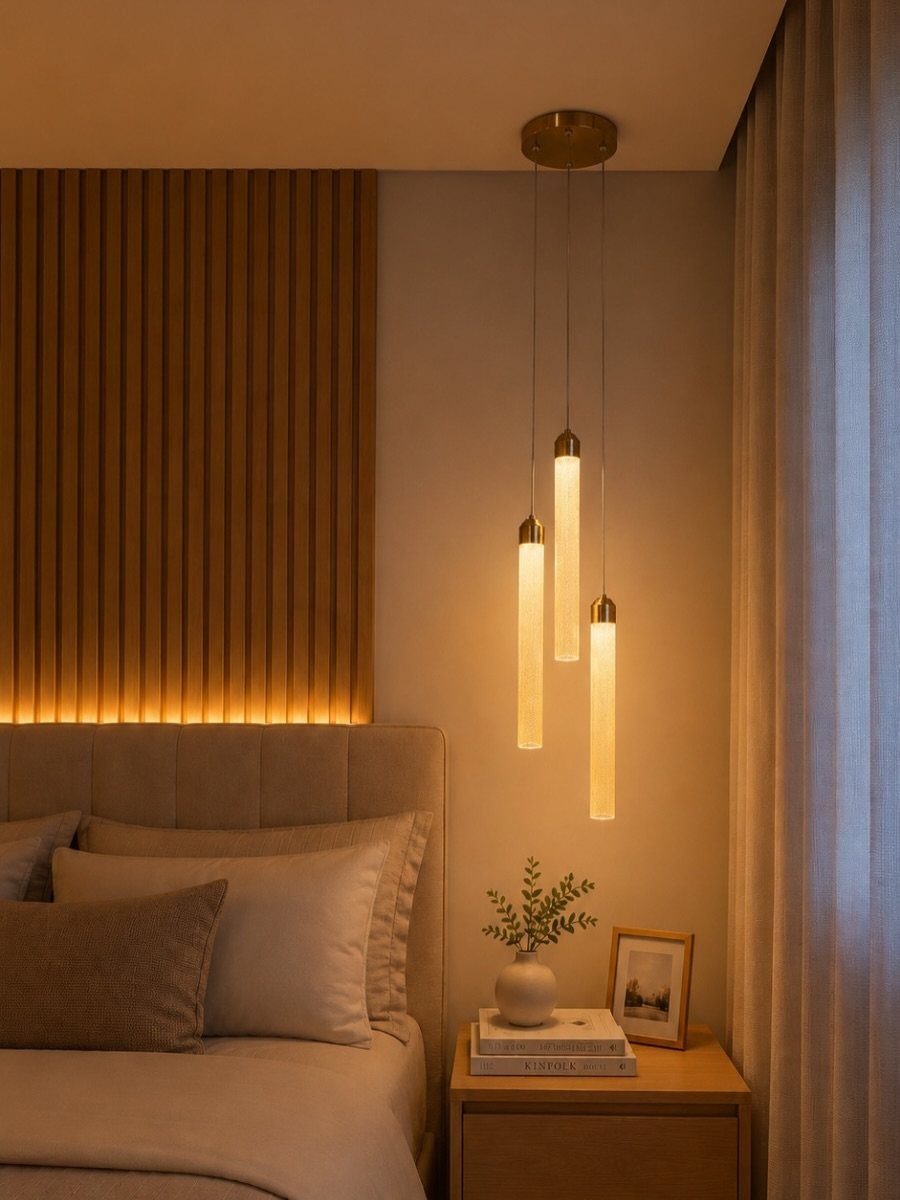
Hanging three narrow pendants over one nightstand does the job of a lamp while leaving the tabletop for books and a photo frame.
Cylindrical pendants with frosted glass diffuse the light evenly, which matters more than the metal finish when you’re trying to avoid harsh shadows on either side of the bed.
Hang them low enough to read as a group over the table, but high enough that you won’t hit them reaching for a glass of water.
A swag kit with a plug and a ceiling hook is the renter-friendly route; hardwiring takes an electrician.
Choose frosted glass over clear so the bulb never shines straight into your eyes.
4. Bedside Table Lamps
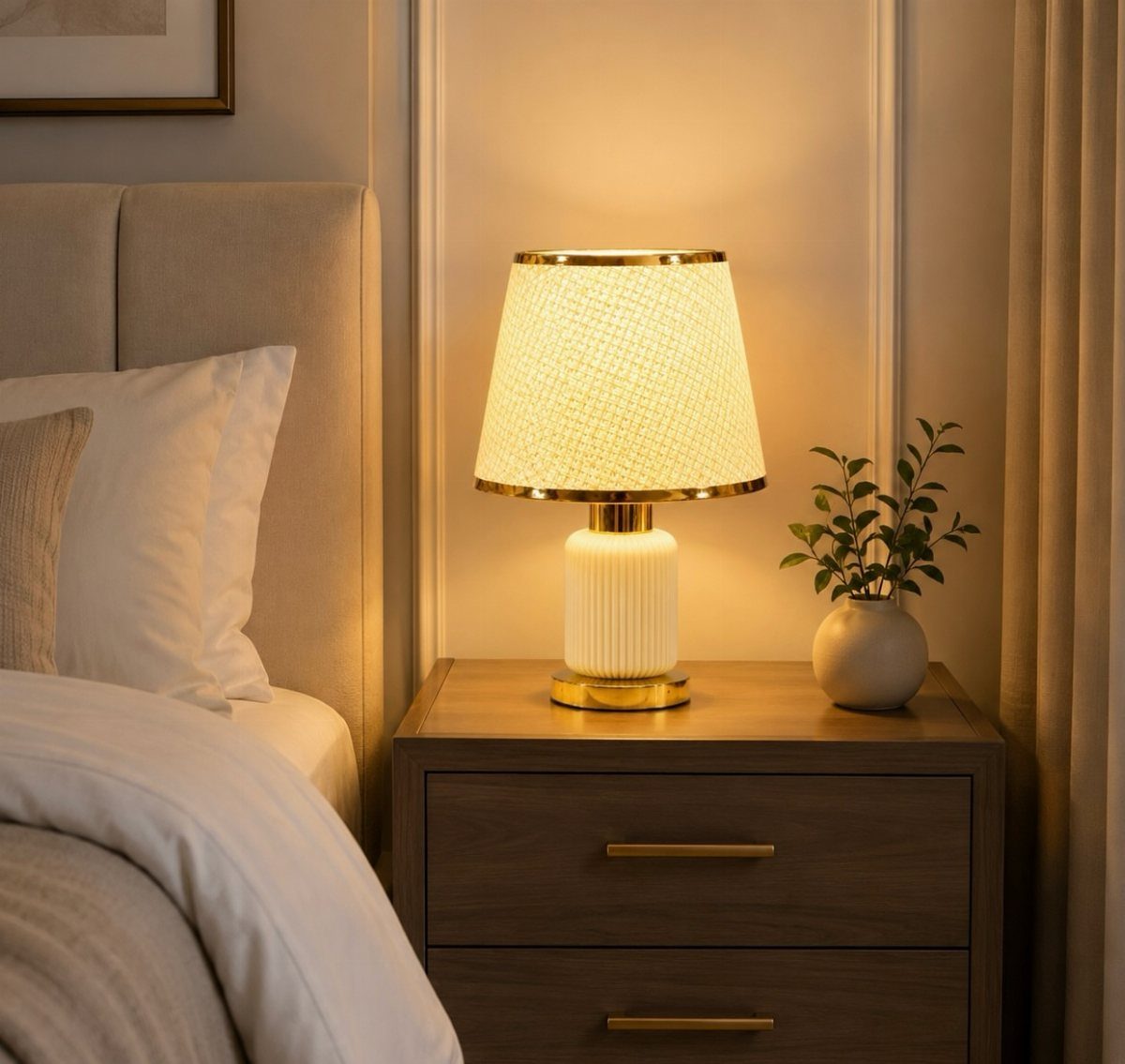
Reading in bed settles the lamp question: the shade should sit near eye level when you’re propped on pillows.
A textured fabric shade spreads a soft, even light, and a fluted white base adds shape without clutter on a dark wood nightstand.
Buy two matching lamps if the bed has two sides. A lamp costs far less than a hardwired fixture and goes wherever you move, which is why I rank it first for renters.
Pick a bulb you like the color of before you fall for the shade.
5. Use of Floor Lamps
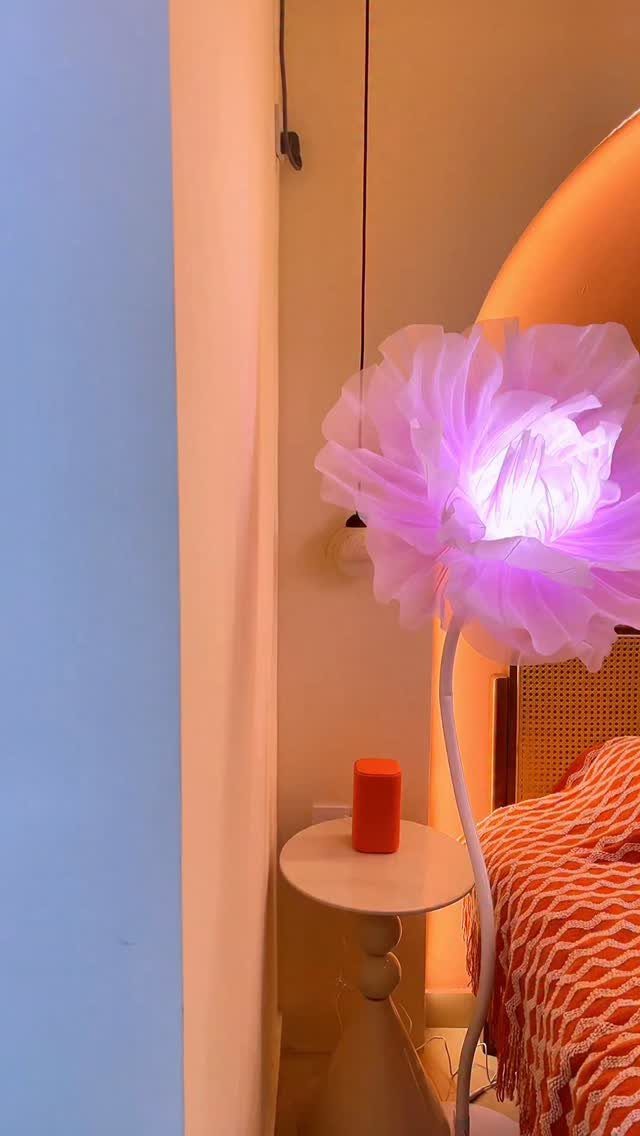
A floor lamp fills a dark corner that the ceiling light and nightstand lamps never reach. It needs no wall space and no wiring, only an outlet and about a square foot of floor.
A playful shape, like a flower-form shade, works as decor even when it’s switched off.
Set it beside a small side table so the light has a surface to fall on, and keep it a few feet from bedding and curtains.
If the room already feels busy, choose a plain shade in a neutral color instead.
6. Layer Lighting
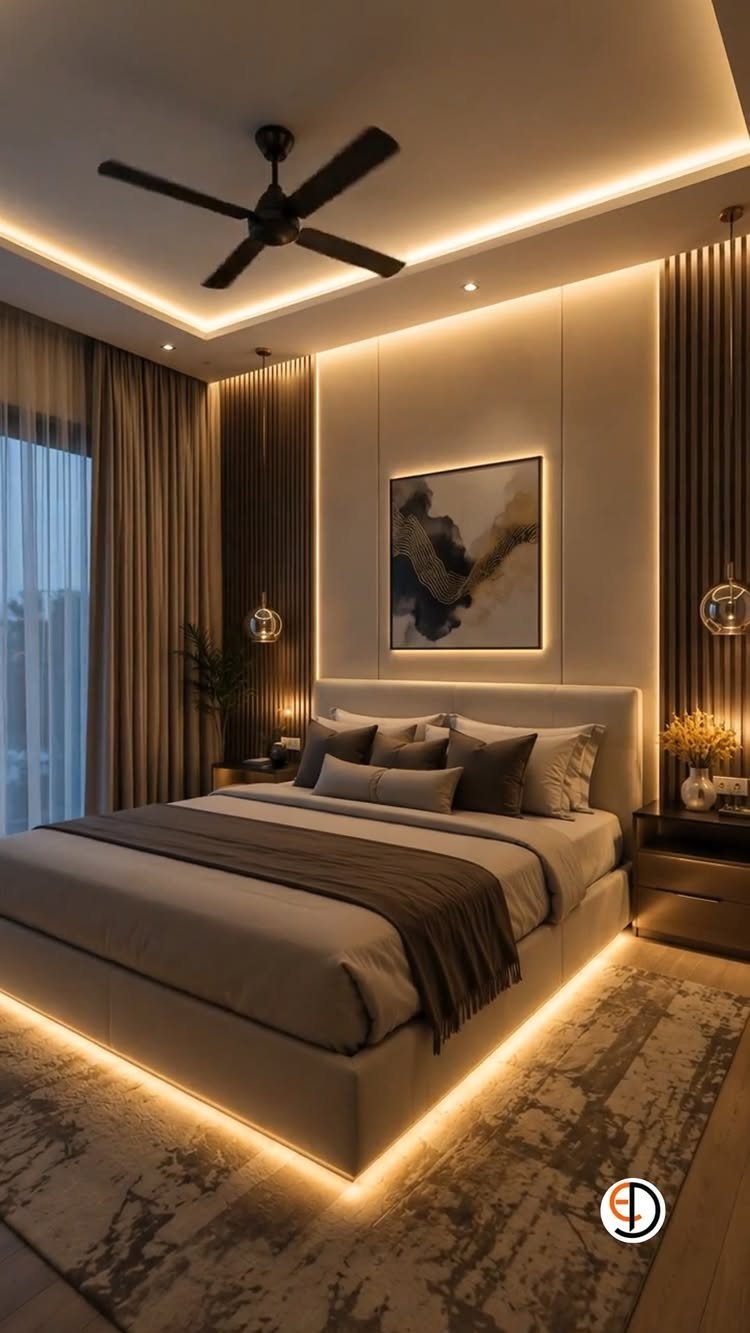
Layering means no single fixture carries the room: ceiling cove lights give the base, pendants add a middle level, and under-bed glow plus a backlit panel supply low accents.
The creator of this room put it simply: a luxury bedroom is built one detail at a time.
That’s a good budget rule too.
Add one layer per weekend or paycheck instead of buying everything together. Start with a lamp, then a plug-in strip beneath the bed frame.
Put each layer on its own switch so you can mix them by mood.
7. Window Treatments for Natural Light
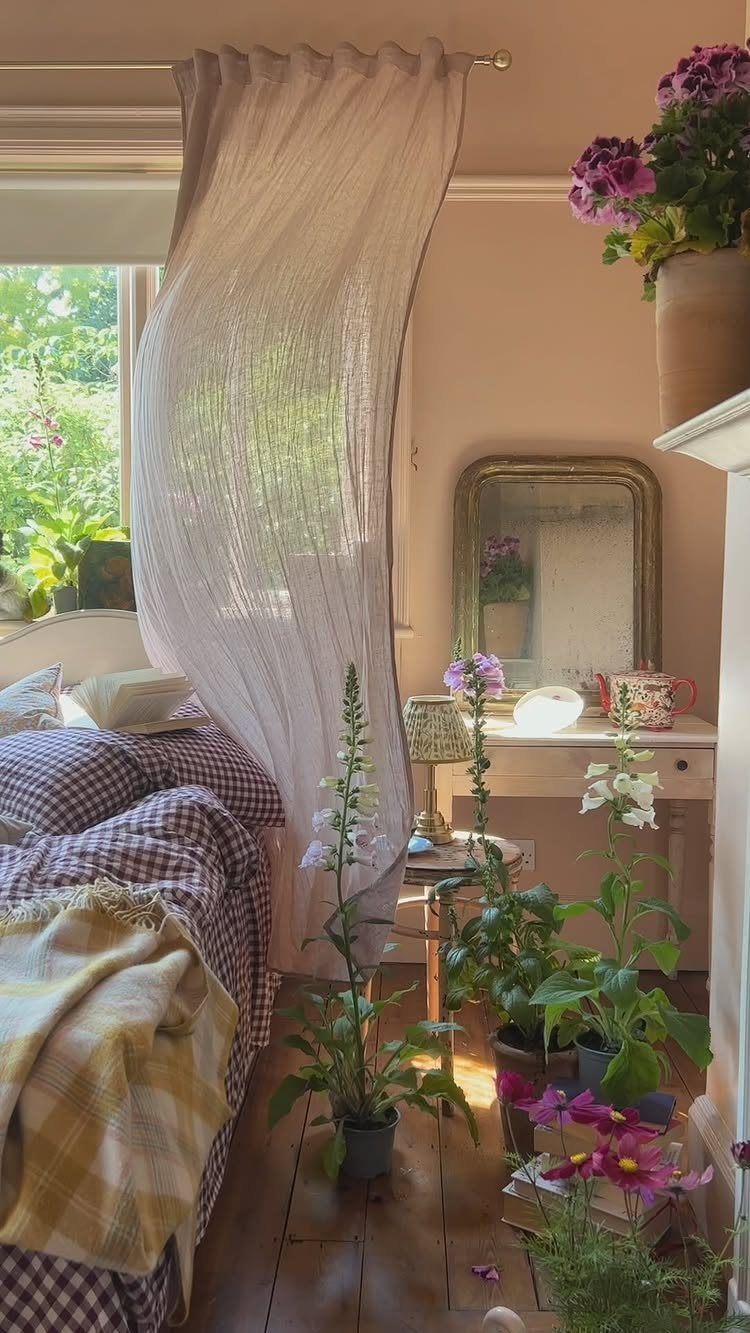
Sheer white curtains let daylight through while softening the view, so the room stays bright without glare on the bed. Against a pink wall, white fabric keeps the color from feeling heavy.
Hang the rod several inches beyond the frame on each side and let the panels fall to the floor so the window reads wider and taller. A tension rod and clip rings suit a renter, since no drilling is needed.
Skip a heavy lining on the sheers if daytime light is the goal; add a second, thicker panel only if you need dark mornings.
8. Warm Light
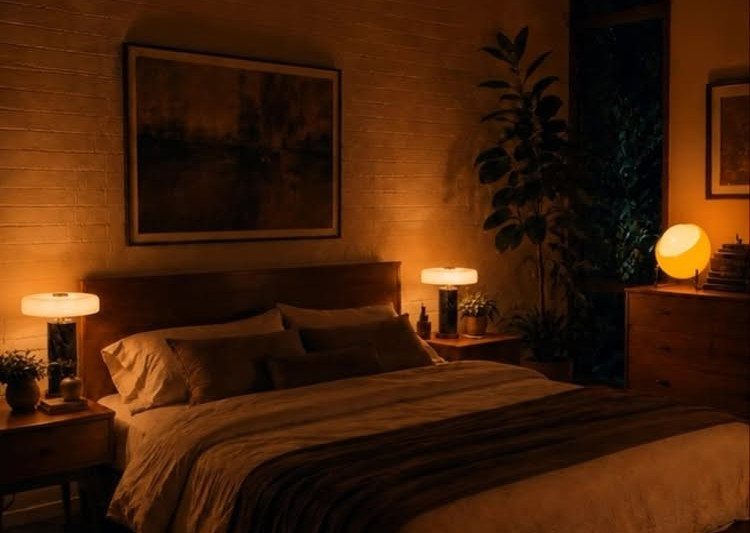
Warm light comes down to the bulb, and a bulb labeled warm white gives the amber glow that makes a wooden bed look richer. Matching bedside lamps with a round lamp nearby keep the glow low and even.
I’d choose the same bulb color in every lamp, because mixing tones makes one corner look yellow and another gray.
Check the label on the box before buying; a lower Kelvin number means a warmer glow.
9. Create a Focal Point
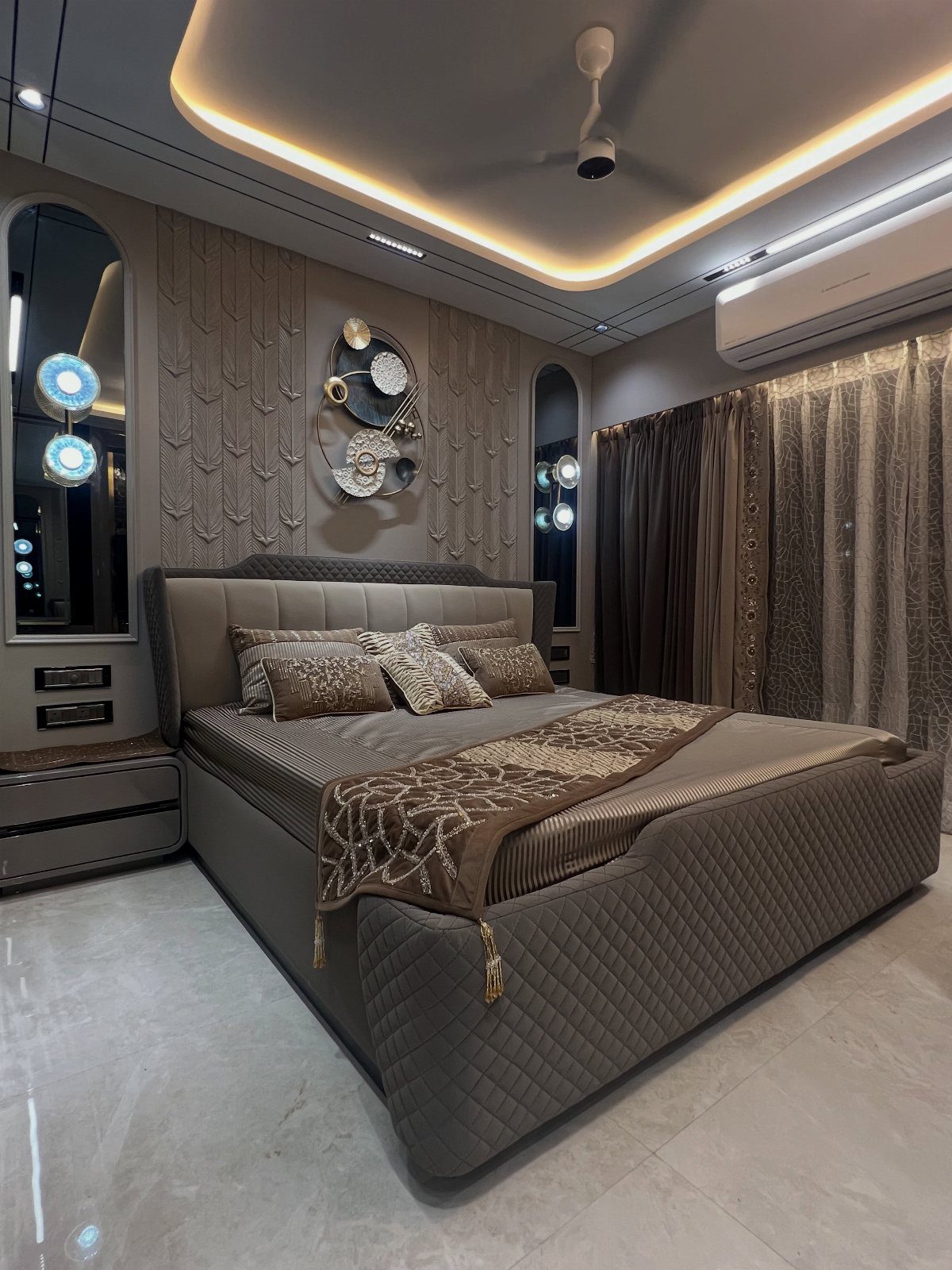
A focal point in light means aiming it at one spot so the eye lands there first.
Cove lighting along the ceiling edge washes a textured accent wall, and the grain or relief shows far more clearly with light skimming across it.
Choose one area to highlight, such as the wall behind the bed, and keep the rest of the room dimmer.
A plug-in LED strip tucked behind a ledge gives a renter a similar wash without wiring.
10. Mixing Styles of Lighting Fixtures

Mixing fixtures works when one thing repeats. A woven pendant, wall sconces and table lamps can share a warm bulb color or a natural material, and then the different shapes read as a plan instead of a clash.
Limit yourself to 2 or 3 finishes. Placing the pendant in the center and the lamps at the sides gives each fixture its own job.
If the room feels scattered, swap one fixture rather than adding another.
11. Dimmers to Adjust Brightness
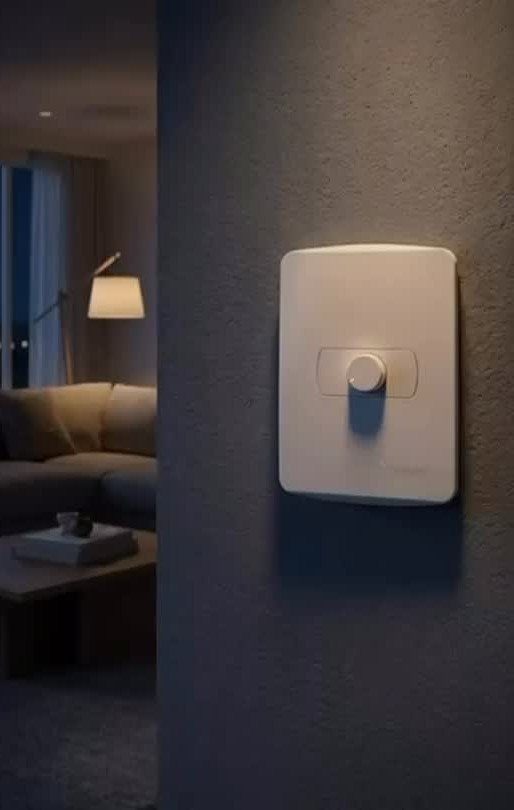
A dimmer lets one fixture act as both a reading light and a night light. A white rotary dial looks tidy on a wall and turns smoothly, so you can set the level without hunting for buttons.
Check that your bulbs are labeled dimmable before you buy a switch, or they may flicker or buzz.
Swapping a wall switch means touching wiring, so turn off the breaker first, or hire an electrician if you’re unsure. Renters can use a plug-in dimmer on a lamp cord instead.
12. Lights in Joinery
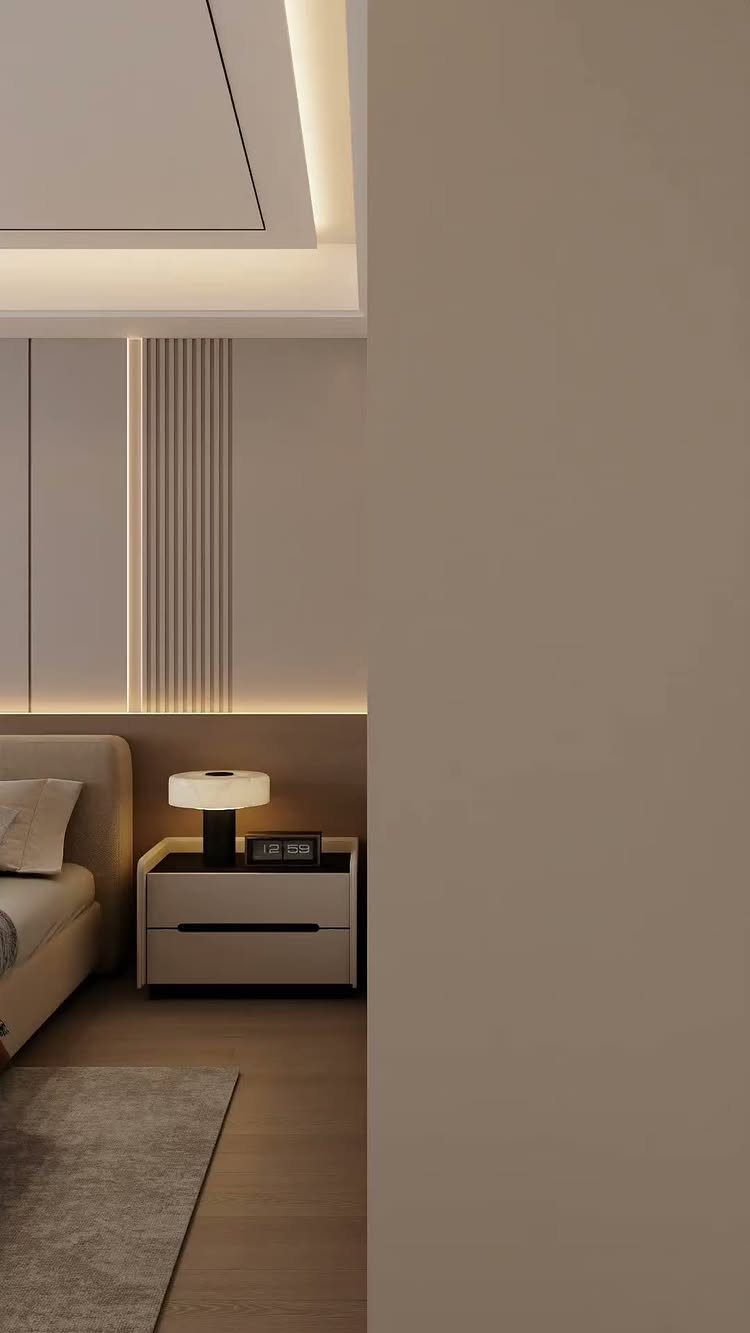
Building light into joinery hides the fixture and leaves only the glow. LED strips set in the ceiling edge and wall panels outline the room softly, which suits a modern bedroom with clean lines.
Plan the channels before the panels go up, since adding strips afterward is harder. For a rental, stick-on strips along the top of a shelf or headboard give a similar effect.
A bright cool strip feels like an office.
Importance of Warm Light
For evenings, a 2700K bulb is the one I reach for, since its soft amber cast feels easier on the eyes than the clinical blue-white of 4000K and up. Bedside lamps and accent lights can go as low as 2200K.
Use 3000K, a warm white, only where the room needs a slightly brighter look, such as general lighting. Bulbs at 3500K and above read neutral to cool and usually work against a bedtime mood.
If the same room has to serve daytime tasks, put a dimmable fixture in it. As bedtime gets closer, lower the intensity and avoid cool-toned brightness.
Dimming Options
No hardwired dimmer?
You still have options. Without ever touching the wall switch, a lamp with 3 settings gives you low, medium and high, while a dimmable smart bulb lets you set any brightness in between.
I’d put the adjustable option on whichever fixture you use most, so one light covers a brighter morning and a low evening glow. The aim is flexibility without harshness, so pick a low setting that is actually low.
Lighting Placement Tips
A ceiling fixture looks best centered on the room or on the bed, and the layout usually makes one of those choices obvious.
Placing a lamp on each side of the room softens shadows and keeps the light from piling up in one spot.
A small lamp on the floor in a dim corner makes the whole room feel calmer and more finished.
A dresser or vanity needs its own task light, bright enough that you can actually see what you’re doing. Keep its color matched to the warm tone of the rest of the room.
Great bedroom lighting is essential to creating a space where you can relax and unwind. Far too often, overhead lighting kills the vibe, and no matter how well-decorated your bedroom might be it still won’t feel quite right without a good lighting setup.





